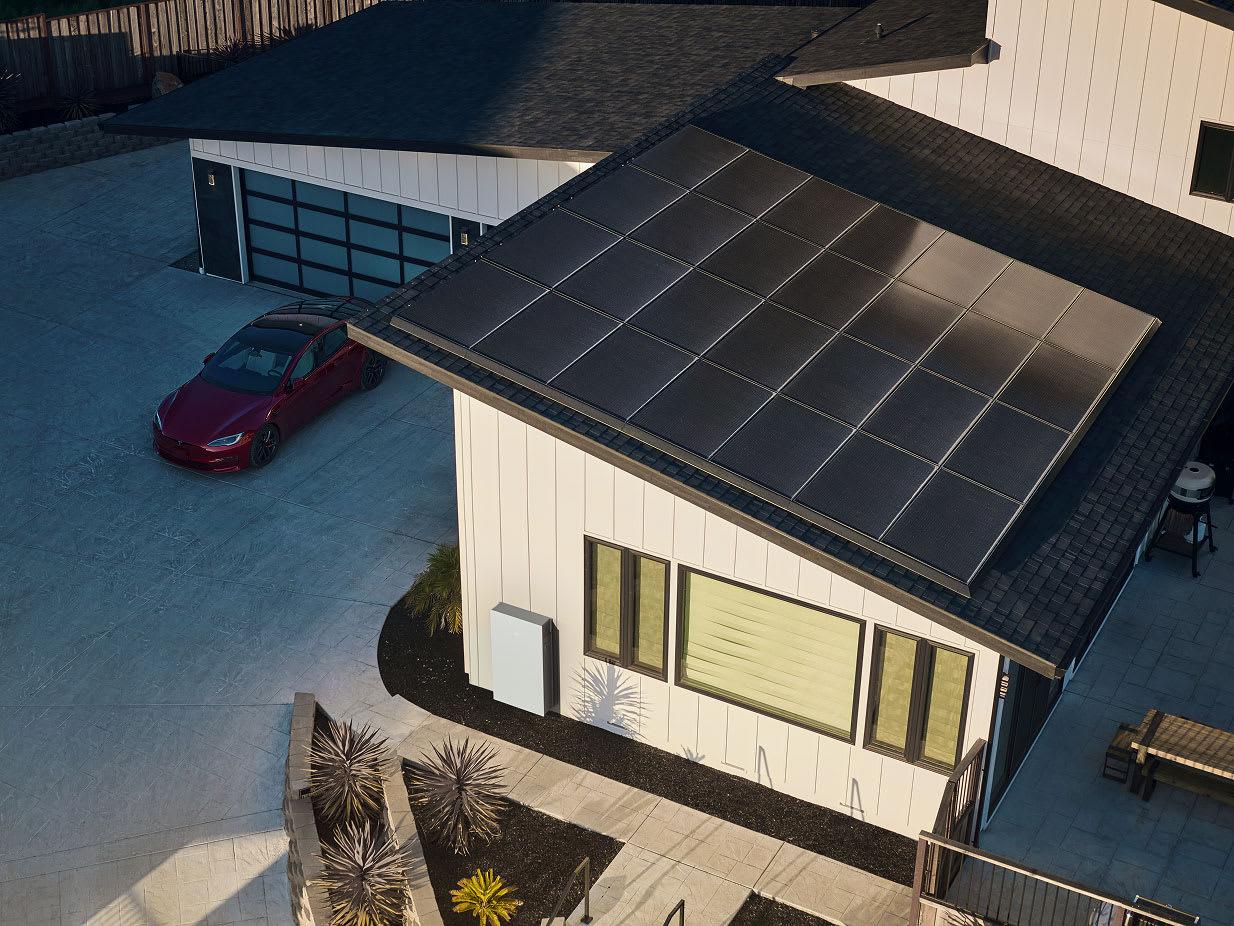
Tesla Powerwall UK: Complete Guide
Expect to pay £8,000-£11,000 for a Powerwall 3 fitted in the UK in 2026. The unit itself is around £5,800 trade; the rest is the Gateway, the certified install, the scaffold, and the DNO paperwork. Tesla don't sell direct you go through a Tesla Certified Installer (TCI), and there aren't many of them, so prices vary by postcode more than by spec.
What you actually get for the money: 13.5 kWh of storage, an 11.5 kW built-in solar inverter (so you don't need a separate hybrid), and whole-home backup that cuts in inside a heartbeat when the grid drops. Pair it with new solar panels on the same contract and HMRC zeros the VAT, saving roughly £1,800.
Quick Answer
A Tesla Powerwall 3 costs £8,000–£11,000 fitted in the UK, or as little as £6,500 if you're already installing solar on the same contract (0% VAT). It stores 13.5 kWh, has an 11.5 kW inverter built in, and provides whole-home backup. Must be installed by a Tesla Certified Installer. Payback is 9-13 years on a typical Octopus tariff.
Last updated September 2026
Fact-checked by John Rooney, Solar Energy Editor. Editorial policy
Tesla Powerwall 3 specifications
The Powerwall 3 landed in the UK in late 2024 and is a complete redesign rather than a refresh of the Powerwall 2. The headline change is the inverter living inside the battery: solar strings wire straight into the unit on DC, skipping a separate hybrid inverter and the double-conversion losses that come with one. Continuous output more than doubled to 11.5 kW, enough to run an induction hob and a kettle through a power cut without tripping out.
| Specification | Powerwall 3 |
|---|---|
| Usable capacity | 13.5 kWh |
| Continuous power output | 11.5 kW |
| Peak power output | 185 A (short duration) |
| Built-in solar inverter | Yes, up to 8 kW solar input |
| Round-trip efficiency | 97.5% (DC-DC) |
| Dimensions (W × H × D) | 609 × 1,098 × 259 mm |
| Weight | 130 kg |
| Operating temperature | -20°C to 50°C |
| Mounting | Wall or floor mount, indoor or outdoor |
| Warranty | 10 years (unlimited cycles) |
| Warranty capacity retention | 70% at 10 years |
| Backup capability | Yes, automatic switchover |
| Scalability | Up to 4 Powerwalls (54 kWh) |
Built-in inverter explained
Unlike most home batteries that require a separate hybrid inverter, the Powerwall 3 has its own solar inverter built in. Your solar panels connect directly to the Powerwall via DC strings, and the Powerwall handles all conversion. This simplifies installation, reduces equipment costs, and improves efficiency.
How much does a Tesla Powerwall cost in the UK?
A Tesla Powerwall 3 costs £8,000-£11,000 fully installed in the UK in 2026. The price includes the Powerwall unit, the Tesla Gateway (for backup and monitoring), installation labour, and electrical connection. Costs vary between Tesla Certified Installers.
| Configuration | Estimated Installed Cost | Notes |
|---|---|---|
| Powerwall 3 only (retrofit) | £9,000-£11,000 | Added to existing solar system |
| Powerwall 3 + solar PV (new install) | £14,000-£20,000 | 4-8 kWp solar system included, 0% VAT |
| Two Powerwalls (27 kWh) | £17,000-£21,000 | Large homes, EV owners, full backup |
0% VAT on Powerwall with solar PV
When installed as part of the same contract as a new solar PV system, the Tesla Powerwall qualifies for 0% VAT. This saves approximately £1,600-£2,200 compared to purchasing the battery separately at 20% VAT. If you are retrofitting a Powerwall to an existing solar system under a separate contract, standard 20% VAT applies.
What affects the price?
- Choice of Tesla Certified Installer
- Complexity of electrical work
- Whether backup gateway is included
- Distance from installer’s base
- Scaffold or access requirements
- Whether installed with new solar PV (0% VAT)
Powerwall cost per kWh
At £8,000-£11,000 for 13.5 kWh, the Powerwall costs approximately £590-£815 per kWh of storage. This is competitive with other premium batteries in the UK, though modular systems like the Huawei Luna or GivEnergy can offer lower per-kWh costs at smaller capacities.
Prices are estimates based on UK market rates in 2026. Always get at least three quotes from Tesla Certified Installers to compare.
Powerwall 3 vs Powerwall 2: what changed?
The Powerwall 3 is a ground-up redesign rather than an incremental update. The biggest change is the integrated solar inverter, which means you no longer need a separate hybrid inverter. Continuous power output has also more than doubled.
| Feature | Powerwall 2 | Powerwall 3 |
|---|---|---|
| Usable capacity | 13.5 kWh | 13.5 kWh |
| Continuous output | 5 kW | 11.5 kW |
| Built-in solar inverter | No (AC-coupled) | Yes (DC-coupled, up to 8 kW) |
| Coupling type | AC-coupled | DC-coupled (or AC-coupled retrofit) |
| Round-trip efficiency | 90% | 97.5% |
| Weight | 114 kg | 130 kg |
| Backup power | Yes (with Backup Gateway 2) | Yes (with Backup Gateway 2) |
| Scalability | Up to 10 units | Up to 4 units (54 kWh) |
| Warranty | 10 years (unlimited cycles) | 10 years (unlimited cycles) |
| Availability (UK) | Discontinued | Current model |
Should I upgrade from Powerwall 2 to 3?
If your Powerwall 2 is working well, there is no urgent reason to upgrade. The Powerwall 2 still has a 13.5 kWh capacity and is supported by Tesla. However, if you are planning a new solar installation or need higher power output for backup, the Powerwall 3’s built-in inverter and 11.5 kW output make it a better long-term investment.
Tesla Powerwall vs alternatives in the UK
The Powerwall is not the only option for UK homeowners. Here is how it compares to the most popular solar batteries available in the UK market.
| Battery | Capacity | Continuous Output | Installed Cost (est.) | Warranty | Key Advantage |
|---|---|---|---|---|---|
| Tesla Powerwall 3 | 13.5 kWh | 11.5 kW | £8,000-£11,000 | 10 years | Built-in inverter, backup, brand |
| Huawei Luna2000 | 5-15 kWh | 2.5-5 kW | £3,800-£7,500 | 10 years | Modular, pairs with Huawei inverter |
| GivEnergy All-in-One | 5-10 kWh | 3.6 kW | £3,500-£6,500 | 10-12 years | Budget-friendly, good app |
| BYD HVS/HVM | 5.1-12.8 kWh | 2.56-5.12 kW | £4,000-£7,000 | 10 years | Modular, works with many inverters |
| SolarEdge Home Battery | 4.6-23 kWh | 5 kW | £4,500-£9,000 | 10 years | Pairs with SolarEdge optimisers |
| Fox ESS ECS | 4-12 kWh | 3.68 kW | £3,200-£6,000 | 10 years | Competitive pricing, growing UK market |
| Sigenergy SigenStor | 6-54 kWh | 5-12 kW | £3,500-£9,600 | 10 years | 5-in-1 modular stack with built-in EV charging; backup needs the Sigenergy Gateway |
When to choose Powerwall
- You want backup power as standard
- You prefer a single all-in-one unit
- You value the Tesla app and brand ecosystem
- You need high continuous output (11.5 kW)
- You want a new solar + battery system in one
When to consider alternatives
- You only need 5-7 kWh of storage
- Budget is a priority (a Fox ESS or GivEnergy setup costs less)
- You already have a Huawei or Solis hybrid inverter
- You want modular expansion and built-in EV charging (see the Sigenergy SigenStor)
- Your installer does not hold Tesla certification
How does the Powerwall work with solar panels?
The Powerwall 3 is a DC-coupled system. Solar panels connect directly to the Powerwall via DC strings, and the built-in inverter converts electricity for your home. This eliminates the double-conversion losses of AC-coupled batteries and achieves up to 97.5% round-trip efficiency.
Daily energy flow
- Morning: Solar panels generate electricity. The Powerwall’s inverter powers your home directly from the panels.
- Midday: Generation exceeds household demand. Surplus electricity charges the Powerwall battery.
- Afternoon: Battery reaches full charge. Remaining surplus is exported to the grid via the Smart Export Guarantee.
- Evening: Solar generation drops. The Powerwall discharges to power your home instead of drawing from the grid.
- Night: Battery depletes. Grid electricity takes over (ideally at a cheaper off-peak rate).
Powerwall operating modes
Self-Powered
Maximises solar self-consumption. The Powerwall stores surplus solar and discharges it in the evening. This is the default mode and the best option for most UK homes.
Time-Based Control
Optimises battery usage based on your electricity tariff. The Powerwall charges from cheap off-peak grid electricity and discharges during expensive peak hours. Ideal for smart tariffs like Octopus Go or Agile.
Backup Reserve
Keeps a percentage of battery capacity reserved for power outages. You choose the reserve level (e.g. 20%). The rest is used for daily solar storage. Essential if you experience frequent power cuts, see our UK blackouts & battery backup guide for context.
Storm Watch
Storm Watch is a Tesla feature that automatically charges the Powerwall to 100% when severe weather is forecast in your area. It uses weather data to anticipate potential power outages and ensures your battery is fully charged before a storm arrives. This feature works automatically in the background via the Tesla app.
Get a quote for Tesla Powerwall installation
Compare prices from MCS-certified installers. Free, no obligation.
Get a Quote ↓Tesla app and monitoring
The Tesla app is widely regarded as one of the best solar monitoring platforms available. It provides real-time data on solar generation, battery charge level, home consumption, and grid import/export, all in a clean, intuitive interface.
Real-time energy flow
An animated diagram shows electricity flowing between solar panels, Powerwall, your home, and the grid in real time. You can see exactly where your energy is coming from and going to at any moment.
Energy history
View detailed charts of solar generation, battery usage, home consumption, and grid dependency by day, week, month, or year. Track your self-sufficiency percentage over time.
Storm Watch alerts
Receive notifications when severe weather is forecast. The app shows when Storm Watch has activated and confirms the Powerwall is charging to 100% in preparation.
Grid services
Tesla offers grid services programmes (like the Tesla Energy Plan) where your Powerwall can export stored energy to the grid during peak demand in exchange for credits or payments. Availability varies in the UK.
Tesla Powerwall installation requirements
The Powerwall must be installed by a Tesla Certified Installer (TCI). Tesla maintains a network of approved installers across the UK who have completed Tesla’s training programme. Installation typically takes one to two days depending on the complexity of the job.
| Requirement | Details |
|---|---|
| Installer | Must be a Tesla Certified Installer (TCI) and MCS-certified |
| Mounting | Wall-mounted or floor-mounted; indoor or outdoor |
| Location | Garage, utility room, or exterior wall. Requires adequate ventilation and access for maintenance. |
| Clearance | Minimum clearances around the unit as per Tesla installation guide |
| Wi-Fi | Requires a stable Wi-Fi connection for monitoring and software updates |
| Electrical supply | Single-phase or three-phase compatible; consumer unit must have space for additional breakers |
| DNO notification | Your installer handles the G98/G99 notification to the Distribution Network Operator |
| Planning permission | Not normally required (permitted development) |
Finding a Tesla Certified Installer
Tesla maintains a list of Certified Installers on their website. You can also request a quote through Tesla directly, who will connect you with a local TCI. We recommend getting quotes from multiple installers to compare pricing. All Powerwall installers should also hold MCS certification, the industry standard for renewable energy installations in the UK.
Find a Tesla Powerwall installer near you
Tesla doesn't sell the Powerwall direct, it's supplied and fitted by Tesla Certified Installers (TCIs), who are also MCS-certified so you keep 0% VAT and Smart Export Guarantee eligibility. The TCI network is smaller than the general solar installer market, so it's worth comparing a few and checking each one holds current Tesla certification before you commit.
The quickest way to compare Powerwall installers near you is to browse MCS-certified installers by county and ask which hold Tesla certification, or request quotes below and we'll match you with installers covering your area.
Powerwall installers by county
Not listed? See all UK counties. We cover MCS solar and battery installers across England, Scotland, Wales and Northern Ireland.
Get Powerwall quotes from local installers
Tell us your postcode and we'll match you with MCS-certified installers near you who can quote for a Tesla Powerwall 3.
What UK Powerwall owners say
The Powerwall has the longest UK track record of any home battery, so owner feedback is plentiful. Here is the recurring picture from UK owners on the r/SolarUK and r/TeslaPowerwall communities and other owner forums, paraphrased:
“Two winters in now. The app is the best of any battery I looked at, and the whole-home backup genuinely kicks in so fast you only notice from the neighbours' lights going out.”
“Paired with Octopus Flux it basically runs itself, charges overnight cheap, exports at the 4-7pm peak. Payback is slow but the backup and the software are why I paid the premium.”
“Hardest part was finding a Tesla Certified Installer with availability, I got three very different quotes for the same job, so definitely shop around on price.”
“No complaints about the hardware, but it's expensive versus a GivEnergy or Fox setup and you can't expand a Powerwall 3 as flexibly. Worth it for me for the backup, maybe not if you just want cheap storage.”
Quotes are paraphrased from UK owner discussions for clarity. For cheaper alternatives, see our home battery brand comparison.
Powerwall backup power capability
One of the Powerwall’s key advantages over most UK home batteries is its built-in backup power capability. When the grid goes down, the Powerwall automatically disconnects from the grid and powers your home from the battery within milliseconds.
Whole-home backup
With 11.5 kW continuous output, the Powerwall 3 can power most UK homes entirely during an outage, including lighting, heating controls, fridge/freezer, broadband router, and even an EV charger at reduced speed. Two Powerwalls provide 23 kW for larger homes.
Partial backup
If your electrical setup does not support whole-home backup, your installer can configure a backup circuit that powers essential loads only (e.g. lighting, fridge, broadband). This is simpler and cheaper to install.
How long does backup last?
With a fully charged 13.5 kWh Powerwall, backup duration depends on your consumption. Running essential loads only (lights, fridge, router, phone chargers, roughly 0.5-1 kW), a single Powerwall can last 13-27 hours. With higher loads like heating and cooking, it may last 4-8 hours. If the sun is shining, the Powerwall continues to charge from solar during the outage, potentially extending backup indefinitely.
Tesla Powerwall: pros and cons
The Powerwall is a premium product with some clear strengths and a few trade-offs compared to alternatives.
Pros
- Large 13.5 kWh capacity in a single unit, no need for multiple battery modules
- Built-in solar inverter eliminates the need for a separate hybrid inverter
- 11.5 kW continuous output, more than double most competitors
- Automatic backup power with millisecond switchover
- Excellent Tesla app with real-time monitoring, Storm Watch, and energy history
- 97.5% round-trip efficiency (DC-coupled)
- 10-year warranty with unlimited cycles
- Indoor or outdoor installation, wall or floor mount
- Regular over-the-air software updates with new features
Cons
- Higher upfront cost than most competitors (£8,000-£11,000 vs £3,500-£7,500)
- 13.5 kWh is the minimum, you cannot start smaller and expand (unlike modular systems)
- Must use a Tesla Certified Installer, limits your choice of installer
- Heavier than most alternatives at 130 kg, may limit wall-mounting options
- Limited to 4 units maximum (54 kWh), though this is sufficient for almost all homes
- Longer payback period due to higher upfront cost (9-13 years vs 8-12 for cheaper batteries)
- Availability can be limited, lead times vary by region
Tesla Powerwall FAQ
How much does a Tesla Powerwall cost in the UK?
A Tesla Powerwall 3 costs £8,000–£11,000 fully installed in the UK. This includes the Powerwall unit, Tesla Gateway, installation, and electrical connection. When installed with a new solar PV system, it qualifies for 0% VAT.
Is the Tesla Powerwall worth it in the UK?
The Powerwall is worth it if you value backup power, a premium monitoring app, and high continuous output. However, it has a longer payback (9–13 years) than cheaper alternatives like the Huawei Luna or GivEnergy. It makes most financial sense when installed with solar PV (0% VAT) and used with a smart tariff.
How long does a Tesla Powerwall last?
Tesla warrants the Powerwall for 10 years with unlimited cycles and a minimum 70% capacity retention. In practice, most lithium-ion batteries last 12–15 years. After the warranty period, the battery will still work but at reduced capacity.
Can the Powerwall power my whole house during a power cut?
Yes, with 11.5 kW continuous output the Powerwall 3 can power most UK homes entirely during an outage. It switches over automatically within milliseconds. For larger homes with high electrical loads, two Powerwalls (23 kW) provide additional capacity.
Do I need solar panels to use a Tesla Powerwall?
No. The Powerwall can be installed without solar panels and used purely for grid arbitrage, charging from cheap off-peak electricity and discharging during expensive peak hours. However, the financial case is strongest when paired with solar PV.
What is the difference between Powerwall 2 and Powerwall 3?
The Powerwall 3 has a built-in solar inverter (the Powerwall 2 does not), more than double the continuous output (11.5 kW vs 5 kW), and higher round-trip efficiency (97.5% vs 90%). Both have 13.5 kWh capacity and 10-year warranties. The Powerwall 2 is now discontinued.
Can I add a Powerwall to my existing solar panels?
Yes. The Powerwall 3 can be retrofitted to an existing solar system. If your panels use a standard string inverter, the Powerwall can operate in AC-coupled mode. Alternatively, you can rewire panels directly into the Powerwall's built-in inverter, bypassing your old inverter.
How many Powerwalls do I need?
One Powerwall (13.5 kWh) is sufficient for most UK homes. A typical household uses 4–7 kWh of electricity between 5pm and 11pm. Two Powerwalls (27 kWh) suit larger homes, those with EV chargers, or homes that want extended backup power during outages.
Does the Powerwall work with Octopus Energy tariffs?
Yes. The Powerwall's Time-Based Control mode works well with smart tariffs like Octopus Go, Intelligent Octopus, and Octopus Agile. It charges from cheap night-rate electricity (7–12p/kWh) and discharges during expensive peak hours (30–40p/kWh).
Does the Powerwall need planning permission?
No. The Powerwall is considered permitted development in the UK and does not require planning permission. It can be installed indoors (garage, utility room) or outdoors on an exterior wall.
Can I get 0% VAT on a Tesla Powerwall?
Yes, but only when the Powerwall is supplied and installed as part of the same contract as a new solar PV system. If you retrofit a Powerwall to an existing solar system under a separate contract, standard 20% VAT applies. Installing solar and battery together saves approximately £1,600–£2,200.
What happens if Tesla goes out of business?
The Powerwall is a standalone device that operates independently once installed. It does not require Tesla's servers to function for basic operation (charging, discharging, backup). However, app monitoring, software updates, and Storm Watch would be affected. This risk applies to any smart battery system.
Related Guides
Sigenergy vs Powerwall 3
Installed prices, capacity, EV charging, backup and warranty compared, with our verdict.
Powerwall vs GivEnergy
Capacity, cost and warranty compared, and why GivEnergy's administration changes it.
Battery Storage
Solar battery costs, sizing, popular models, and payback analysis.
Sigenergy SigenStor
Sigenergy SigenStor review: all-in-one battery, hybrid inverter, and EV charger.
GivEnergy Review
GivEnergy batteries and inverters: product range, pricing, app, and comparisons.
Sources
- Tesla: Powerwall UK
- MCS: Microgeneration Certification Scheme
- Ofgem: Smart Export Guarantee (SEG)
- HMRC: 0% VAT on Energy-Saving Materials
- DESNZ: UK Energy Consumption Statistics
Last updated: September 2026
John Rooney is the founder of Solar Info and has been covering the UK solar energy market since 2023. He researches every battery and inverter brand against manufacturer datasheets, MCS and Ofgem data, and feedback from the MCS-certified installers in our directory before publishing.
Get a Tesla Powerwall Quote
Compare Powerwall installation prices from MCS-certified installers. Free, no-obligation quotes.